Calgary Phil Musician Maxwell Stein on Finding Connectivity in the Fibre Arts
By Maxwell Stein Photo Dennis Envoldsen
A life in music is a true gift. It’s marked by extremes — moments of transcendence balanced by the deeply humbling, even humiliating ones. It’s not a life I think anyone chooses so much as one that chooses you.
Music has always been a safe place for me — a space to be creative, to explore individuality, and to grow continually. I came to it as an escape. At eleven, I didn’t understand why my classmates in sixth grade seemed to go out of their way to bully me. As an adult, I see that kids can sense difference — and sometimes fear it. I was a quirky, talkative, artsy boy, and perhaps something in me reflected parts of themselves they weren’t ready to face. Choir and band became my refuge, and in those rooms, I found not only safety but passion — and, eventually, a calling.
My inclination toward music gave me confidence (and sure, it also helped that I shot up to over six feet tall at 15 years of age). During my undergraduate studies, though, I began to encounter the tougher realities of a musical life — the competitive auditions, the constant self-comparison, and the humbling experiences of performing (and sometimes falling flat) in front of peers. Art, at its core, is about community and shared connection, but pursuing it professionally can feel like a constant test of your sense of self. Not everyone can withstand that pressure or handle the level of work and time it takes to achieve excellence at an instrument.
Amid those challenges, I needed an outlet — something quieter, more tactile — a way to sit in peace between rehearsals and auditions. That’s when I discovered another great artistic love: the fibre arts. I started knitting shortly after I happened upon a gorgeous yarn shop. I distinctly remember the colours, textures, and smells of the yarn. It was an exhilarating experience for the senses. I was thankful to be a knitter, since I had chosen to do my undergraduate in the Arctic tundra that is Ann Arbor, Michigan. Even if school was stressful, at least my ears were warm under an ever-growing collection of handmade toques.
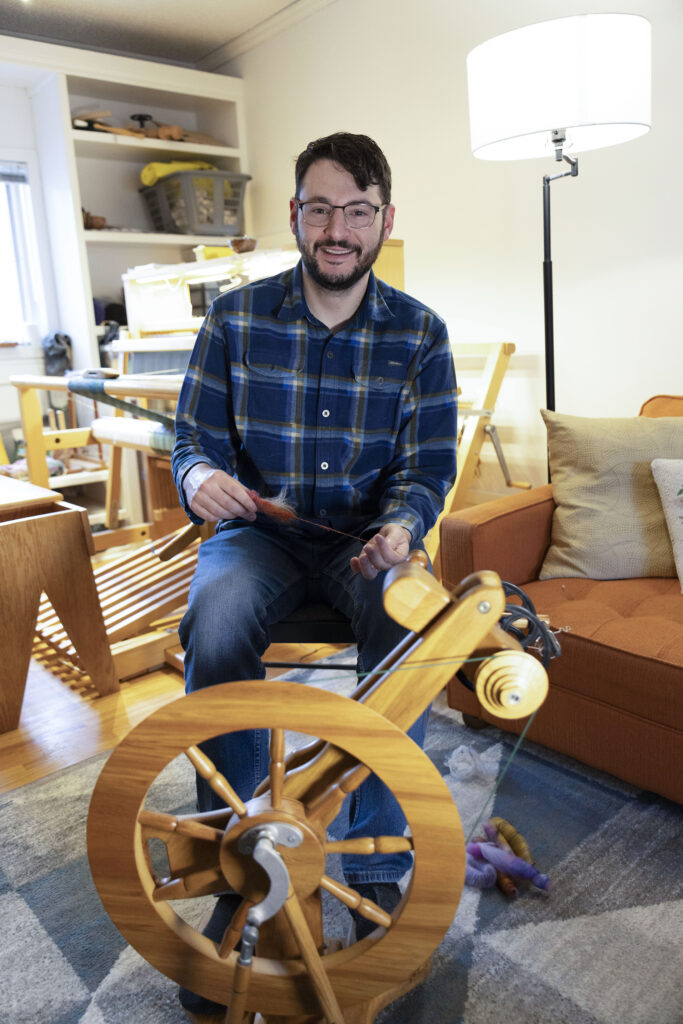
As my music career deepened, so did my fascination with fibre. I learned to spin my own yarn, to weave fabric on looms, and to process raw fleece into finished textiles. What has struck me most since joining the Calgary Philharmonic Orchestra is how similar these two worlds are. In both music and textiles, we speak about texture, colour, density, and tonality. These aren’t coincidences — they reveal how interconnected all art forms are. Can you stand in front of a painting of a mountain/river landscape and honestly tell me you can’t feel a touch of wind on your arms or hear the sound of the rushing water? Or perhaps you recall the feel of the couch in your childhood home? Or its colour? Chances are those sensory memories are accompanied by sound — laughter, conversation, the hum of a TV, music of its own kind.
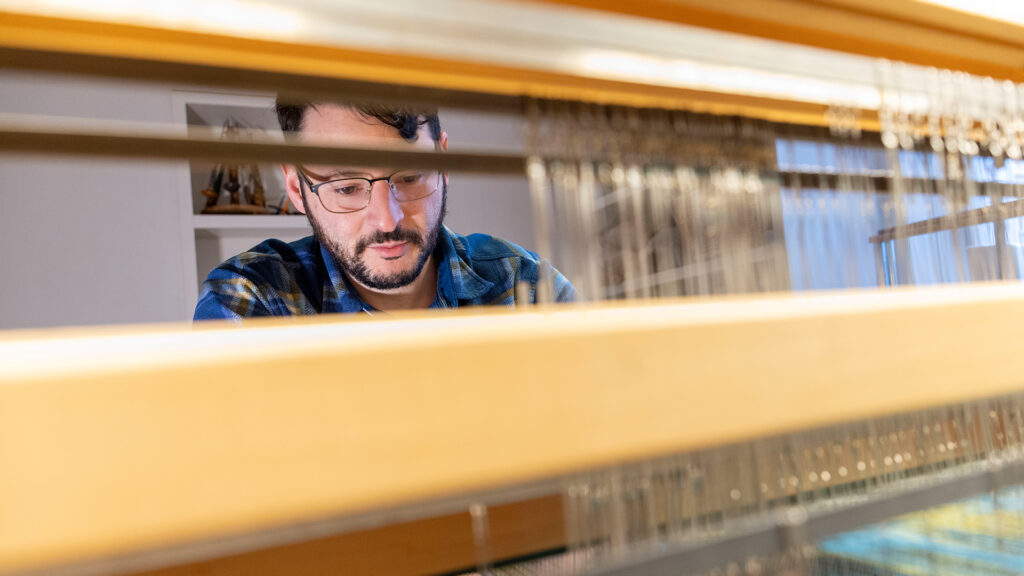
These days, I find deep satisfaction in the tangible nature of fibre arts. Unlike music, which exists in fleeting moments, textiles leave behind something you can hold — a physical manifestation of time, patience, and creativity. Recently, I’ve been spinning yarns for textured woven tapestries on my rigid heddle loom and working with bamboo yarn for the first time on a self-designed eight-shaft twill scarf on my 45-inch floor loom (a large loom the size of a decent sofa couch). When I’m not performing with the Calgary Philharmonic or teaching music, you’ll find me knitting, spinning, weaving, or washing raw fleece. And when I’m too tired to do any of those things, I do the next best thing — I read about textiles or listen to podcasts on yarn. (Yes, yarn podcasts exist. And yes, they are DELIGHTFUL.)
Making music with the Calgary Philharmonic truly is a dream come true, and I bring the same dedication, patience, and joy to every concert that I bring to my loom, knitting needles, and spinning wheels. I’m not someone who does anything halfway. Whether I’m pouring my heart into the horn on stage or weaving a scarf, I endeavor to make something honest — something that holds a bit of warmth, and maybe, a bit of me.
Latest Posts:
- A Woven Experience

- The Spice of Life… and Concert Programing
- 21 Questions with Assistant Principal Bass Jonathan Yeoh

- Many Voices as One
- All About the Music of La Vida Loca: Latin Pop Hits!