
BY ZOLTAN VARADI

Just over forty years ago — in September 1985 — the Calgary Philharmonic kicked off its 30th season in an epic way with the gala opening of the Jack Singer Concert Hall, its brand-new home constructed specifically for orchestral performances.
Performing Gustav Mahler’s Eighth Symphony for the first time in Western Canada, the Orchestra and the Calgary Philharmonic Chorus, led by then Music Director Mario Bernardi, were joined by members of the Edmonton Symphony Orchestra, a choral group from Vancouver, two Calgary-based children’s choirs, and several vocal soloists. All told, some 500 musicians appeared on stage to celebrate this new chapter in the history of the Calgary Phil.
The next day’s headline in the Calgary Herald labelled the event a “stunning success,” undoubtably bringing a sigh of relief to both musicians and staff; just three days prior the Phil and the Jack were making news for entirely different reasons: “Fires, flood bring real-life drama to arts centre,” rang the copy across the top of the Herald’s City section.
The drama sprang from a series of mishaps during rehearsals for opening night. First, a hose in the sprinkler system in the canopy above the stage began to leak, giving the musicians below – including renowned Canadian opera singer Maureen Forrester — a bit of a soak. Shortly thereafter two separate fires broke out in electrical control rooms.
“I remember going to the security desk and the fire alarm panel was kind of lit up like a Christmas tree, which is not what you want to see,” recalls Kay Harrison, who had the unique perspective of being a member of the Chorus while also working for the management team overseeing the constuction of the Jack Singer Concert Hall and what was then called the Calgary Centre for the Performing Arts (now called Werklund Centre).
Once the issues were resolved and things calmed down, Harrison, who was due at Chorus rehearsal, quickly switched gears from her role as an on-site mechanical-electrical coordinator. “I literally walked out the front of the building [on 8 Ave] and came round to the stage door [on 9 Ave]. “[I was like] ‘Yeah, oh right, I’m just a member of the choir here,” she chuckles.

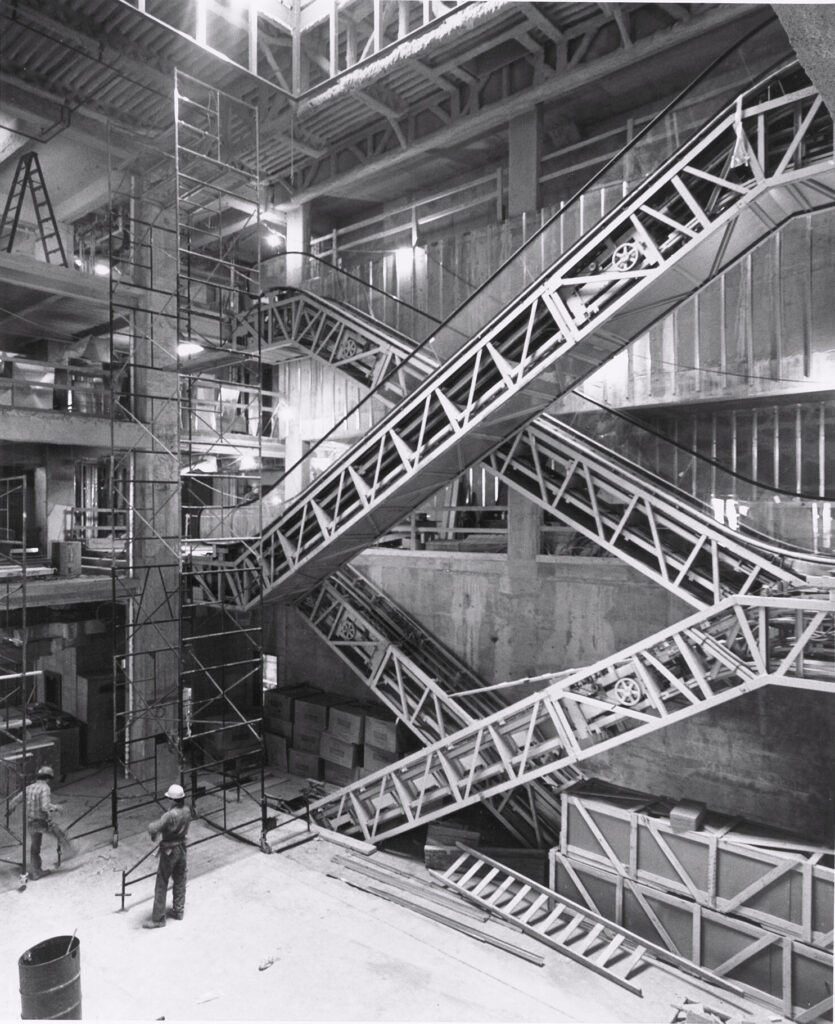

1. Painting by Lauren Shipton 2. Courtesy Werklund Centre. 3. University of Calgary, Archives and Special Collections
Last-minute bumps aside, the Jack Singer was (and continues to be) a marvel in which even the smallest of details contributes to making the hall a state-of-the-art venue for the performance of symphonic sounds.
“The acoustic requirements were huge and also taking those requirements through absolutely every trade,” says Harrison. “You don’t want any background noise, so you’re basically isolating the different areas so you don’t have anything punching through from one area to another — even if it’s just a nail through some insulation into the drywall, because you’re transferring vibration and noise through that.”
She explains that it is for this reason the duct work in the building is oversized, which prevents vibrations from coming through. Similarly, throughout the entire performing arts complex, there is a two-inch isolation gap in the concrete structures between all of the resident companies and the many backstage areas, as well as in places such as the elevators adjacent to the Jack Singer Lobby.
“There was a complete break in the structure, so there was no carry over of any vibrations from one structure to another,” says Harrison.
By the time Harrison was assigned to work on the project in 1983, construction had begun in the Public Building in which the Jack Singer is situated, as it had for the Calgary Centre for the Performing Arts as a whole. Nonetheless, she saw the project evolve in various ways. This included ironing out technical details on matters such as humidification — an important detail given Calgary’s climate — which hadn’t been correctly accounted for at the outset of construction. But it all meant being a firsthand witness to how public support continued to be courted even after the foundations for the structure had been laid.

(Courtesy Werklund Centre)
“It was obviously [due to] the input of some very special people that the centre even got up and running — if Martha Cohen & Co. hadn’t put money in or hadn’t had the guts to say we’re going to go, it would have never got off the ground,” Harrison says of Cohen, Vera Swanson, and Sandra LeBlanc, a groundbreaking trio who joined forces to create the Calgary Region Arts Foundation, which was responsible for realizing the vision of the multi-venue performing arts centre downtown. “It was very much a case of you had to get [the project] in the ground so that the public could see that something was happening. Without that, it wouldn’t have happened, I don’t think.”
Among the more novel fundraising ventures to occur before the hall was completed was one in which musicians of the Calgary Philharmonic donned Calgary Phil-branded hard hats and performed in an embryonic version of the hall.
was actually when it was still under construction,” remembers Calgary Phil’s longtime Music Librarian, Rob Grewcock, of the ‘Hard Hat Concert’ that took place a year before the Jack officially opened. “We didn’t have flooring — it was all concrete.”
For Grewcock, the benefits of the new concert hall extended beyond sonic considerations. Before it opened, the musicians, as well as the music library, were based at the Jubilee Auditorium, while the Calgary Phil’s administrative offices were located downtown. The Jack Singer Concert Hall allowed for the integration of the entire organization under one roof.
“If I needed to go into the office, which seemed to be quite a bit those days, I’d have to drive downtown and park, submit parking expenses — a bit of pain, really,” he says. “This is much better.”
Where Grewcock and Harrison’s perspectives ultimately converge is over the superior sound of the Orchestra in the Jack. Both point out that the Calgary Phil’s previous home base, the Jubilee, a fine venue where the Phil continues to perform several times a season, was designed as an all-purpose venue able to serve everything from opera to rock concerts. In contrast, every aspect of the Jack Singer, from materials used in construction to the adjustable acoustic canopy, was put in place to specifically enhance symphonic sounds.
The building’s legacy of excellence continues to this day as new generations of audience members delight in the complete package — acoustics, atmosphere, programming — that is the Jack.
Harrison, who remains a Chorus member to this day, reflects on the moving experience of performing on opening night, a feeling that for her had an added dimension because of her involvement in the construction of the building:
“As I had been working on it for two-and-a-half years before it opened, you’d be thinking, ‘okay, this is where the choir is going to be.’ I could stand there and look out to where the audience would be,” she says. “[There was] a sense of achievement that everything was coming together for when you would actually perform. Opening night was very special to me.”